Bigfoot Sightings on the Olympic Peninsula: A Field Assessment
The Location
The Olympic Peninsula occupies the northwest corner of Washington State, separated from the mainland by Hood Canal to the east and the Strait of Juan de Fuca to the north. At its core sits Olympic National Park — 922,000 acres of wilderness that is, by almost any measure, one of the most biologically dense and least-traversed landscapes in the contiguous United States. Surrounding the park, and continuous with its ecology, lies Olympic National Forest and a patchwork of state and tribal land. Taken together, the protected interior of the Peninsula constitutes one of the largest blocks of roadless terrain anywhere south of Canada.
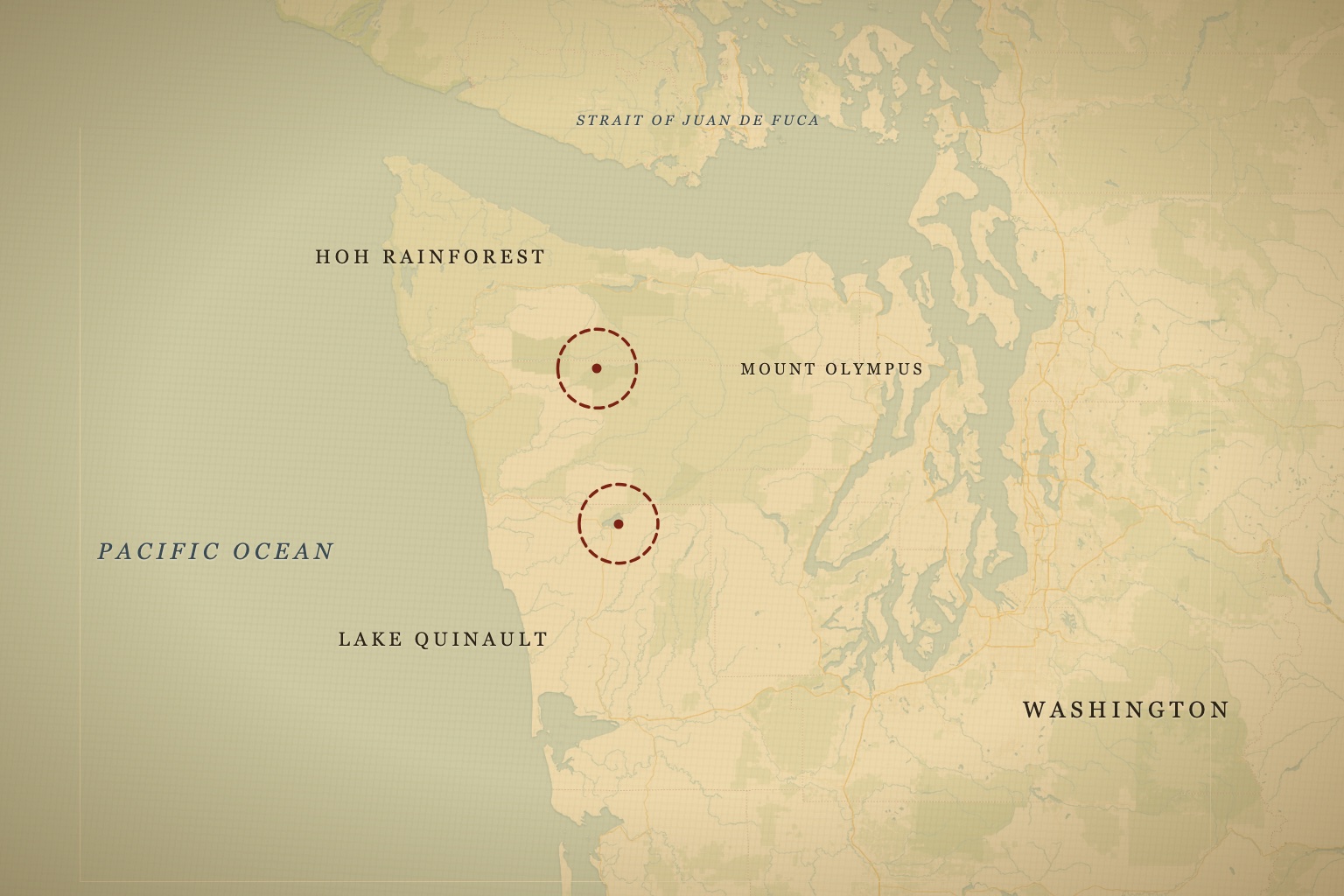
The terrain within that boundary is extreme. Elevation ranges from sea level at the Pacific coast to 7,980 feet at the summit of Mount Olympus. The western valleys — the Hoh, the Queets, and the Quinault — are fed by orographic rainfall that exceeds 140 inches per year in some zones, making them among the wettest places in the lower 48. Air moving inland off the Pacific is forced upward by the Olympic massif, cools, and dumps its moisture on the windward slopes before it ever reaches the rain shadow on the eastern side of the range. The result is one of only a handful of temperate rainforests on Earth, and the most extensive in North America.
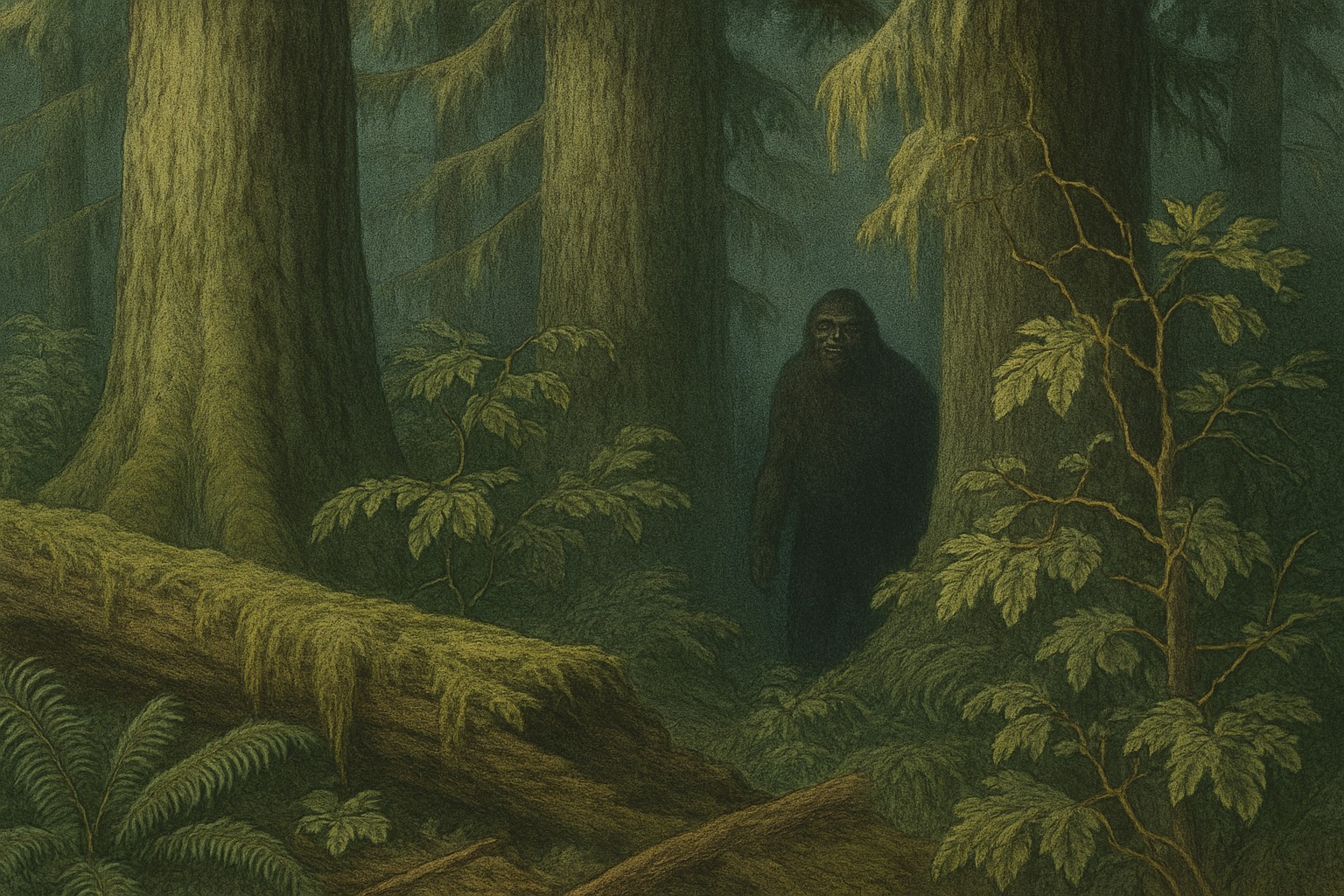
It is worth dwelling on what that rainfall produces at ground level, because the ecology is the entire reason this region merits attention. The canopy is old-growth Douglas fir, Sitka spruce, and western red cedar, many of the trees 200 to 500 years old, with trunks exceeding 12 feet in diameter. Beneath them, a second canopy of bigleaf maple drips with club moss and licorice fern. The understory — sword fern, salmonberry, devil's club, and a tangle of fallen nurse logs — is so dense that in summer, ground-level visibility is measured in yards rather than miles. A person standing in the Hoh in July can lose sight of a companion at twenty or thirty paces. This is not an abstraction. It is the single most important fact about the place. Whatever moves through this forest does so behind a wall of green that defeats the human eye at conversational distance.
The land was not empty before it was a park. The Quinault Indian Nation, along with the Hoh, the Quileute, and other Coast Salish and Chimakuan peoples, has lived in this territory for thousands of years. The Quinault homeland centers on the river and lake that bear its name, and the Nation's relationship to these forests is continuous and present, not historical. Among the oral traditions of the peoples of this coast are accounts of large, hair-covered forest beings — figures who keep to the deep timber, who are powerful and to be respected, and whose presence is woven into the moral and physical geography of the land. These traditions long predate any television show, any tourist economy, any BFRO report number. A serious researcher does not treat them as corroborating evidence in the forensic sense, but it would be a failure of basic respect — and of intellectual honesty — to pretend they are not part of the record of what people have described in this specific place over a very long time.
For those who want to walk it, the access points are well defined even if the backcountry beyond them is not. The Hoh Rain Forest Visitor Center, reached by the Upper Hoh Road off US 101, anchors the Hall of Mosses and Spruce Nature trails and the long Hoh River Trail that runs east toward Mount Olympus. The Quinault valley is reached by the South Shore and North Shore roads off US 101 at Lake Quinault, with trailheads into the Enchanted Valley and the Colonel Bob Wilderness. The Queets Campground sits at the end of a 14-mile unpaved road and is among the most remote developed sites in the lower 48. Sol Duc, Staircase, and the Elwha drainage open the northern and eastern flanks. Beyond these thin corridors of access, the interior is on foot only. The nearest large population center, Seattle, is roughly three and a half hours by road, and most of that interior has never had a road at all. If a large, unknown primate were going to persist in North America, this is structurally one of the more plausible places for it to do so.
The Sightings
The Olympic Peninsula's report history is long, geographically clustered, and internally consistent enough that it warrants careful examination on its own terms. What follows is not a complete catalog — the BFRO and independent databases hold hundreds of entries for the three-county area of Jefferson, Clallam, and Grays Harbor — but a representative sample of the categories of evidence the region produces.
The reports that carry the most weight come from professional woodsmen, and the road-crossing account is the recurring type in the Quinault valley files: a logger or surveyor with a decade or more on the ground reports a large bipedal figure crossing a forest-service road at dusk — seven to eight feet, proportionally broad through the upper body, a fluid, extended stride with no perceptible head-bob — moving at speed across the open road cut before disappearing into the treeline. What these witnesses are consistently emphatic about is the point that matters most to an experienced observer: they have seen Olympic black bears in every posture and condition, and this was not a bear. The value of such reports is precisely that the observers are the opposite of naïve. They have a professional baseline for what large mammals on logging ground look like, and what they describe falls outside it.
Along the Hoh River corridor — the primary drainage through the park's interior — multiple independent backpacker and hunter reports from the 1990s and 2000s describe nighttime auditory encounters: a deep, resonant vocalization — not owl, not elk, not coyote, lower in frequency than any of them, and sustained for several seconds at a stretch. These accounts cluster along the same trail miles and share a structure: the sound arrives after dark, at the edge of camp, and is answered by nothing the witnesses can identify.
Threaded through many of these reports is a detail that does more analytical work than any single sighting: the smell. Witnesses across the Peninsula, in different decades and with no plausible contact between them, independently describe a powerful odor — most often rendered as some combination of sulfur, wet dog, and musk — that precedes or accompanies an encounter. It is described as overwhelming, nauseating, and unlike the scent of any familiar animal. The independence of these accounts is the point. A man on the Hoh in 1996 and a hunting party near the Queets in 2007 had no way to coordinate their language, yet they reach for the same three notes. Social contagion can spread a visual stereotype easily; it is much harder to explain why an idiosyncratic olfactory signature recurs across unrelated witnesses unless something in the environment is actually producing it.
The Olympic Peninsula has also produced some of the most-studied track casts in the BFRO database. Olympic black bears leave distinctive five-toed, clawed tracks that experienced trackers readily separate from human plantigrade prints; the casts from the Quinault and Hoh drainages match neither. Several specimens from the region preserve what casting analysts describe as dermal ridges — fine skin-texture detail across the sole and toes, analogous to the friction ridges on a human hand. That detail is genuinely difficult to dismiss, and it forces a hard binary: either these casts represent an elaborate, sustained, and so-far-undetected hoaxing operation sophisticated enough to fabricate primate dermatoglyphics in remote terrain over years, or they record the foot of a real, large, unclassified primate. Both possibilities are uncomfortable. Neither is trivial. Honest field researchers have argued each side, and the casts remain among the most-debated physical artifacts in the entire subject.
Finally, the Hoh corridor produces tree structures with a regularity that has drawn its own line of documentation. Researchers and hikers repeatedly report broken and twisted saplings — green wood, snapped and folded rather than cleanly cut — arranged in deliberate-seeming X patterns or arches, sometimes woven so that several stems cross at a height and angle that wind and snow load do not readily explain. Skeptics note correctly that storm damage, snow press, and animal browsing can all bend young trees, and that pattern-seeking humans are quick to read intent into chaos. But the specific morphology — living saplings twisted and interlocked at chest-to-head height, recurring along the same drainages — is harder to wave off than a single anomalous lean, and it is one of the more replicable field observations the region offers.
What the Shows Covered
Finding Bigfoot, the Animal Planet series that ran from 2011 to 2018, came to the Peninsula directly: the Season 8 opener, "Squatch Wars: US vs Canada" (2016), sent the team into the Olympic Peninsula and British Columbia to settle which side of the border was — in the show's vocabulary — squatchier, splitting up to meet witnesses and run night investigations on both sides. The team — Matt Moneymaker (BFRO founder), James "Bobo" Fay (researcher and field operator), Cliff Barackman (analyst and the group's most careful track man), and Ranae Holland (biologist and designated skeptic) — worked their standard toolkit: call-blasting recorded vocalizations into the forest at night, wood-knocking to simulate territorial communication, thermal imaging sweeps of treeline, and interviews with local witnesses.
Holland served the show's most structurally useful function wherever it filmed: for each piece of evidence, the mundane alternative — a thermal "biped" that is as easily a bear risen on its hind legs or a misjudged tree trunk; vocalizations distorted by dense understory and river noise; the well-documented unreliability of human distance and height estimation in low light. Her counterarguments were consistent and unsentimental, and the show was better for her refusal to be swept along.
What television field work genuinely conveys about this region has little to do with proving anything and everything to do with scale. Night operations in terrain like the Hoh corridor communicate something the written reports cannot: the environmental density of this ecosystem makes surveillance essentially futile. Even with thermal gear, the closed canopy overhead and the continuous river noise create conditions in which a large animal could move within fifty feet of an observer and remain entirely undetected. This is a place built to hide things.
Expedition Bigfoot (Travel Channel, 2019–present) reached the same conclusion by the numbers. After anchoring its first season in the mountains of the Northwest with data-driven habitat modeling, drone thermal, and long continuous field deployments, the production moved its entire second season (2021) to the Olympic Peninsula — the algorithm's own habitat criteria pointed squarely at the Olympic interior, and the team spent weeks working it, a search compressed mid-season by wildfire outbreaks across Washington. No confirmation came out of it. The terrain won again.
Field Assessment
The Olympic Peninsula earns serious attention as a sighting concentration for reasons that hold up under scrutiny independent of any single report.
Start with the habitat, because it is the part that requires no faith at all. The Olympic interior is genuinely one of the last large roadless areas in the contiguous United States — a near-million-acre core that has never been fragmented by roads, logging, or development. It supports black bears, Roosevelt elk, cougars, and other large mammals at high density, which is the relevant point: this ecosystem already sustains large, secretive animals year-round. The food base is more than adequate for a large omnivore — salmon runs, abundant elk, heavy berry and understory crops, and green forage in every season. The terrain defeats systematic survey, and human presence is sparse, seasonal, and confined to a few thin road corridors. None of this proves anything. But these are precisely the conditions under which a large, elusive animal could persist undetected, and there are vanishingly few places left in the lower 48 where all of them hold at once.
The skeptical explanations deserve to be stated plainly and granted their real force, because each describes a mechanism that demonstrably operates. Black bears stand and walk bipedally far more readily than most people assume, and a bear on its hind legs at dusk, behind summer understory, is a genuinely good candidate for many sightings. Witnesses in dark forests are primed to read ambiguous shapes and sounds as large and threatening. Communities with a pre-existing Bigfoot framework amplify and reshape ambiguous experiences over time. These are not strawmen; they are real, and any honest assessment has to assume they account for some — probably most — of the report volume.
What they do not cleanly account for is the specificity and the consistency. Misidentification is always possible for a given encounter. It is a much weaker explanation for why the precise sensory details recur — the same stride geometry with no head-bob, the same three-note odor signature, the same low-frequency multi-second vocalization, the same twisted sapling structures along the same drainages — across independent witnesses separated by decades and by experience level, from weekend backpackers to fifteen-year logging veterans. The convenient positions at both ends of this subject tend to underweight that consistency. The show's boosters skip past it toward a conclusion the evidence does not earn; the reflexive skeptics dissolve it into a list of named biases without reckoning with how oddly stable the specifics actually are. The harder, more honest read sits in between: a recurring signal that is not proof, but is not noise either.
What would move this from "plausible" to "confirmed" is physical evidence that survives the chain-of-custody requirements of peer review — a body, a tissue sample, or a track series documented by a credentialed field team under controlled conditions. None of that exists for the Olympic Peninsula, or anywhere else, and intellectual honesty requires saying so without hedging.
What does exist is a pattern of encounters, in one of North America's most intact wilderness ecosystems, that has not been satisfactorily explained — reported by people who deserve to be heard rather than mocked, in a landscape uniquely suited to concealing exactly the kind of animal they describe. That is not proof. But it is a reason to keep looking, and to look carefully.
Track sighting locations from this post on the interactive map.
Free account · mark visited sites · build your field list.
Open the tracker