Champ: The Lake Monster of Lake Champlain
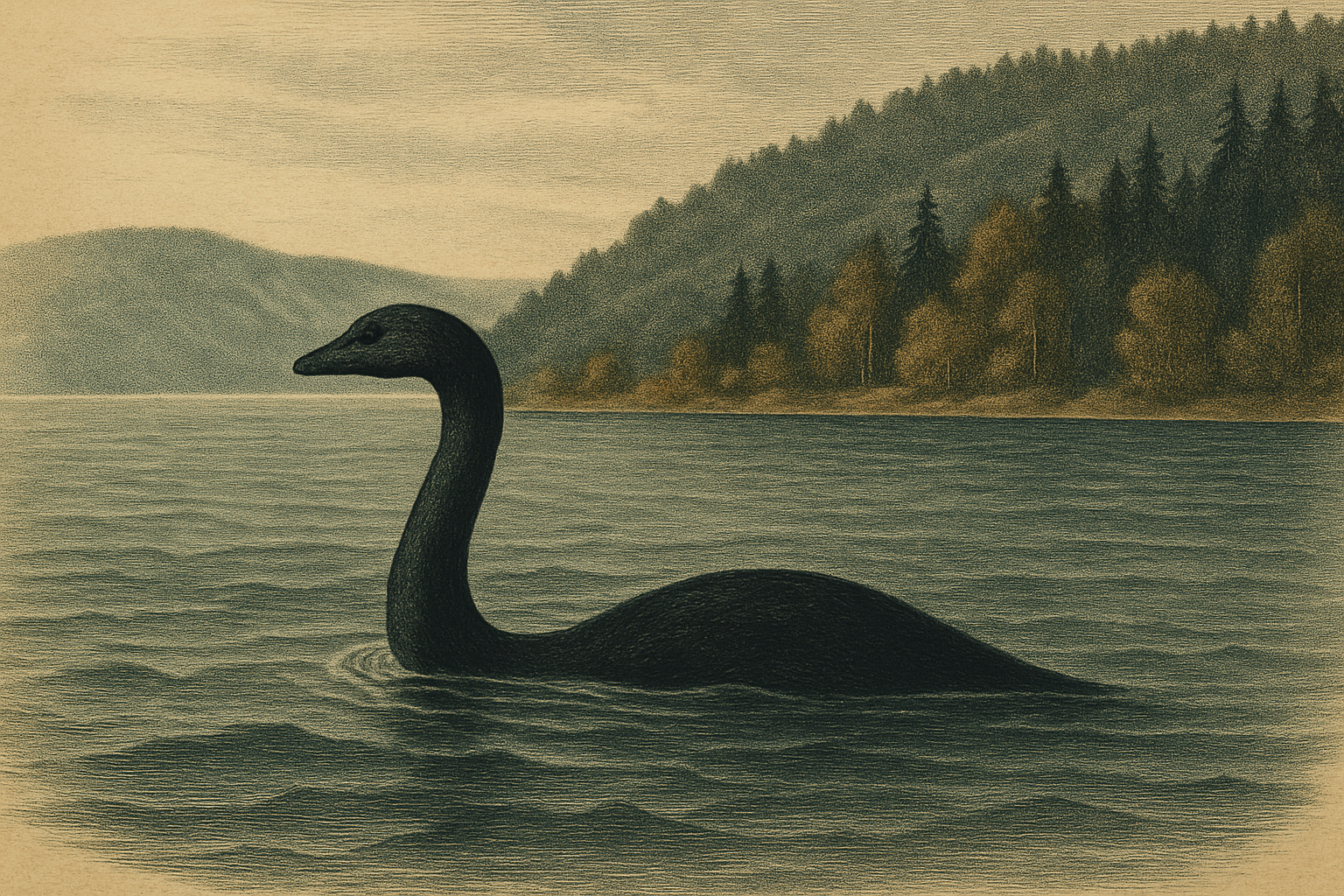
On July 5, 1977, a Connecticut woman named Sandra Mansi was standing on the eastern shore of Lake Champlain near St. Albans, Vermont, when she saw something rise out of the water perhaps 150 feet offshore. She had her camera. What she photographed — a dark, curved neck and head lifting above the surface against the far shoreline — became the single most reproduced piece of evidence in the entire Champ tradition, and it has resisted a clean explanation for nearly half a century. Mansi never sought fame. She kept the print in a family album for years before it surfaced publicly. When investigators later tried to relocate the exact spot to gauge scale, they found the shoreline she described but could not pin the object's size with certainty. That ambiguity is the whole story of Champ in a single frame.
The photograph reached a wider audience only around 1980, when it appeared in the press and eventually in The New York Times, and it drew the attention of serious researchers precisely because it lacked the tells of an obvious fake. Mansi had been picnicking with family, was not a monster hunter, and had no apparent motive to construct a hoax and then sit on it. The very features that make the image compelling — the isolated setting, the single hurried snapshot, the absence of any boat or landmark for scale — are also the features that make it impossible to verify. It is a photograph that invites belief and refuses proof in equal measure, and that tension has kept it in circulation for decades.
The Location
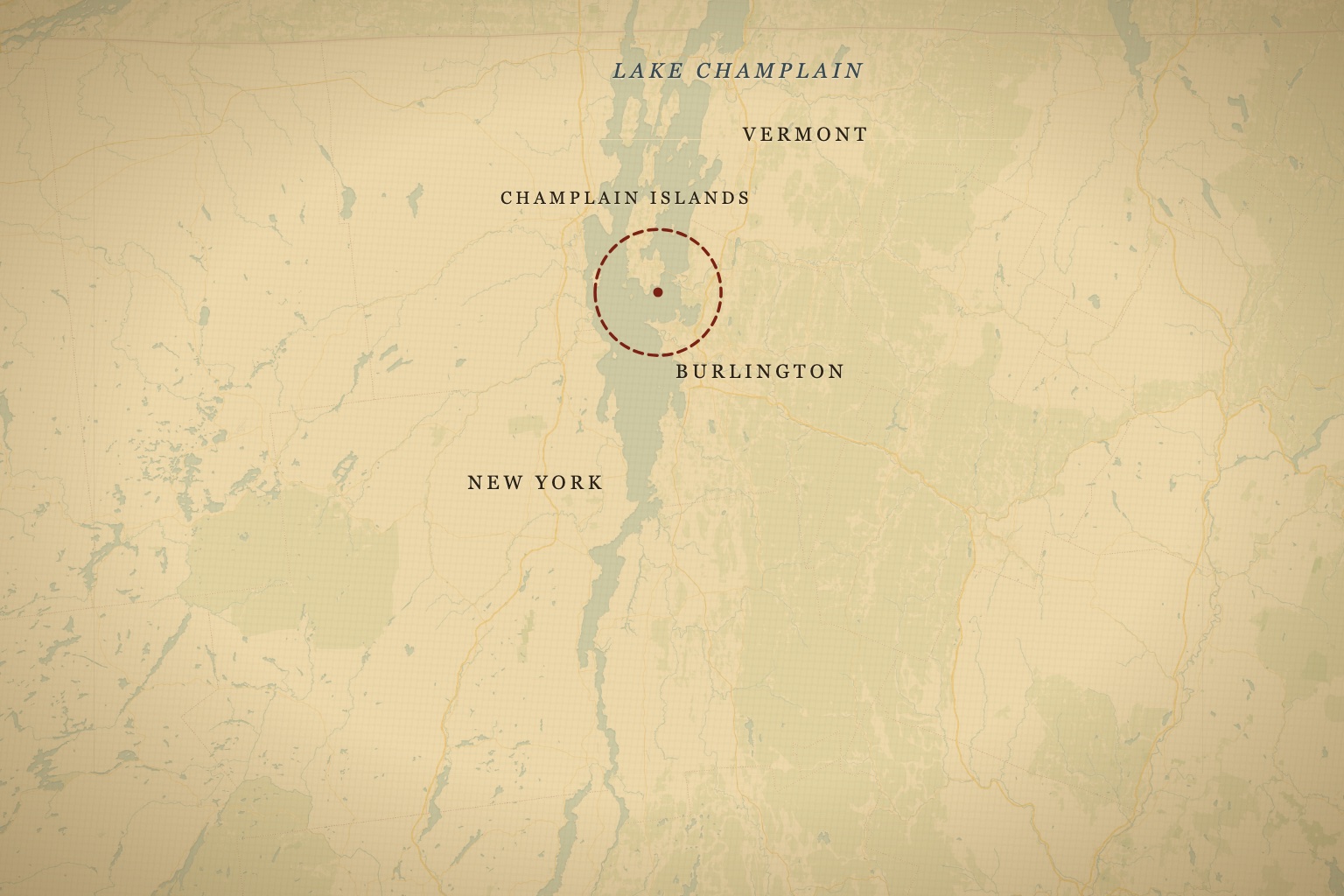
Lake Champlain is a long, narrow freshwater lake straddling the border between Vermont and New York, with its northern tip crossing into Quebec. It runs roughly 120 miles north to south and reaches about 12 miles across at its widest, draining north through the Richelieu River toward the St. Lawrence. It is large — the sixth-largest freshwater lake in the United States by surface area — and, more importantly for anyone weighing the reports, it is deep. Soundings in the main channel south of Burlington reach around 400 feet, with a cold, dark, poorly mixed bottom that almost no one ever surveys.
The lake sits in the trough between two mountain ranges: the Green Mountains of Vermont to the east and the Adirondacks of New York to the west. Its shoreline is a mix of settled and wild — the city of Burlington anchors the Vermont side, while long stretches of the New York shore and the Champlain Islands remain rural and lightly traveled. The water is glacially cold, and the lake was once connected to the sea as the Champlain Sea after the last ice age, a detail cryptozoologists have leaned on to argue that a relict marine population could have been trapped as the land rebounded. Whatever one makes of that hypothesis, the basin is genuinely large, deep, and cold enough that a big animal could go unobserved for long stretches.
The geography matters in practical ways too. The lake's irregular outline — full of bays, narrows, and islands including the Champlain Islands and larger landmasses like Grand Isle and Isle La Motte — breaks the water into pockets where a wake or a dark shape can appear and disappear quickly against a busy shoreline backdrop. The southern portion narrows to a river-like channel that behaves very differently from the broad, open water south of Burlington. Winds funnel down the valley between the mountain ranges and stir the surface into standing waves and confused chop, exactly the conditions under which distance and size become hardest to judge. A lake this shape and this size does not offer clean sightlines; it offers glimpses. That physical reality shapes both the sightings and the difficulty of ever confirming them, because the same features that could conceal a large animal also generate a steady supply of ambiguous shapes for the eye to interpret.
The lake also supports a genuine, documented population of large fish, including lake sturgeon — a species that can grow to substantial lengths and lives near the bottom of exactly the kind of deep, cold water Champlain provides. That single fact hangs over every account, because a sturgeon breaking the surface is a real animal doing something unusual, not a fantasy.
The Sightings
Champ reports predate almost every other American cryptid tradition. Local histories credit the region's Abenaki people with accounts of a large creature in the lake long before European settlement. The earliest widely cited European-era report is attributed to a lake steamer captain and dates to the 19th century, describing a long, dark animal in the water — though the often-repeated 1609 Samuel de Champlain account has been shown by researchers to be a misreading; Champlain described a large fish, not a monster, and the "sighting" as usually quoted is a later embellishment. Honesty requires flagging that, because it is one of the most repeated false facts in the field. The invented Champlain quote has been reprinted so often, in books and on tourist signage, that it now travels as settled history — a reminder that a cryptid tradition can accumulate false pedigree as easily as genuine reports.
The reliable modern record begins in the 19th century and thickens through the 20th. In July 1873, newspapers reported a sighting near the New York shore, and P.T. Barnum famously offered a reward for the creature's hide — a stunt that says more about Barnum than about Champ, but which fixed the animal in regional lore. That year seems to have been a turning point for the legend's visibility: the combination of press coverage and Barnum's showman's reward pulled a folk tradition into the newspapers, where it could compound. Reports cluster around several areas: the broad water south of Burlington, the bays near Port Henry, New York, and the channels among the Champlain Islands.
Port Henry embraced the tradition more than any other town, erecting a signboard listing decades of local sightings and holding an annual "Champ Day." The sign, a fixture of local identity, names witnesses and dates and has become a small monument to the town's relationship with the story — part civic pride, part tourist draw, part running record of a community that decided to take its lake monster seriously. What matters analytically is the consistency of the descriptions across unconnected witnesses: a long neck, a small head, one or more humps breaking the surface, and rapid movement leaving a wake — a profile witnesses reach for repeatedly, from boaters to shoreline residents to, in more than one case, groups of people watching the same disturbance at once.
That last category — multiple-witness sightings — is what separates Champ from a purely individual illusion. A single observer can misjudge a floating log or a diving bird, but when several people on a dock or a boat describe the same moving object at the same moment, the explanation has to account for a shared perception, not just one mistaken eye. The descriptions are not perfectly uniform — humps are counted differently, lengths are estimated wildly, colors range from black to greenish-brown — but the underlying silhouette recurs with enough regularity that it has become the region's default image of the animal.
The Evidence
The physical evidence for Champ is thin, and it should be treated as such. There is no track, no tissue, no bone. Nothing has ever washed ashore, been caught in a net, or turned up as a carcass — a notable absence in a lake that has been fished, boated, and lived beside for centuries. The case rests almost entirely on eyewitness accounts and two contested categories of recording.
The first is the Mansi photograph of 1977. It has been examined by researchers including Roy Mackal and later analysts, and the debate has never fully resolved. There is no obvious model, rig, or hoax artifact visible in the image, and Mansi's own account was consistent over years of retelling. The central problem is scale: without a fixed reference in the frame, the object could be very large or relatively small, and the lost photographic spot means the size can't be reconstructed. Analysts have argued over the wake, over whether the dark form is attached to something below the surface, and over the play of light on water — but every line of argument runs into the same wall, which is that the photograph records an appearance, not a measurement. It remains unexplained rather than confirmed. That is an unusually stable verdict for a piece of cryptid evidence, and it is worth dwelling on: the image has neither been debunked nor validated in nearly fifty years of scrutiny.
The second is a body of underwater audio. In 2003, a research group deployed hydrophones in the lake and recorded a series of clicks and echolocation-like sounds that some specialists compared to signals produced by cetaceans — animals not known to inhabit a landlocked freshwater lake. The recordings are genuinely anomalous and genuinely unexplained, but audio alone cannot establish what produced them, and freshwater acoustics are notoriously easy to misread. Sound behaves strangely in a cold, deep, stratified basin, where boat noise, ice, and reflections off the bottom and shoreline can all masquerade as biological signals. What the recordings do is add a second, independent category of anomaly to a case that otherwise leans almost entirely on human eyes — and independent categories, even weak ones, are harder to wave away than a single stream of testimony.
Beyond these two, the evidence is the accumulated testimony itself: the Port Henry sign, the newspaper archive stretching back to the 1800s, and the steady trickle of modern shoreline and boat reports. It is a large body of anecdote and a very small body of anything physical, and any honest assessment has to hold both facts at once.
The case has also drawn sustained national television coverage — Unsolved Mysteries first profiled Champ in a September 1992 episode, MonsterQuest devoted a 2007 episode ("America's Loch Ness Monster") to testing whether a relict plesiosaur population could plausibly survive in the lake, and The CW's Mysteries Decoded returned to the search in a 2022 investigation. None of it settled anything, but it kept the Mansi photograph and the hydrophone recordings in front of a national audience decade after decade.
The Verdict
Lake Champlain occupies an unusual place in cryptozoology: a huge, deep, cold northern lake with a report tradition that runs from Abenaki oral history through 19th-century newspapers to a still-unexplained 1977 photograph and a set of anomalous 2003 recordings. That is a longer and more geographically coherent record than most lake-monster claims can show. It is also a record with a hard ceiling — no specimen, no track, no confirmable image at scale.
The skeptical explanations are real and probably account for much of the volume: sturgeon (which grow long and can break the surface), otters swimming in file, floating logs, standing waves, and the well-documented difficulty of judging size and distance on open water. Each of these is not a hand-wave but a documented phenomenon on this specific lake, with its real fish population, its wind-driven chop, and its debris-carrying currents. A line of otters swimming nose-to-tail produces exactly the sequence of "humps" that witnesses describe, and a partially submerged log riding a wave can appear to move under its own power. What none of those cleanly dissolve is the persistence — the same long-necked, humped profile described by unconnected witnesses across two centuries and two states, and the two independent anomalies, one photographic and one acoustic, that neither believers nor skeptics have managed to close.
Champ won't be settled from shore. If anything moves this case, it will come from the lake's dark 400-foot channel, and from someone patient enough to keep a hydrophone running long after the tourists have gone home.
Track sighting locations from this post on the interactive map.
Free account · mark visited sites · build your field list.
Open the tracker