The Dover Demon: A Single Weekend That Never Repeated
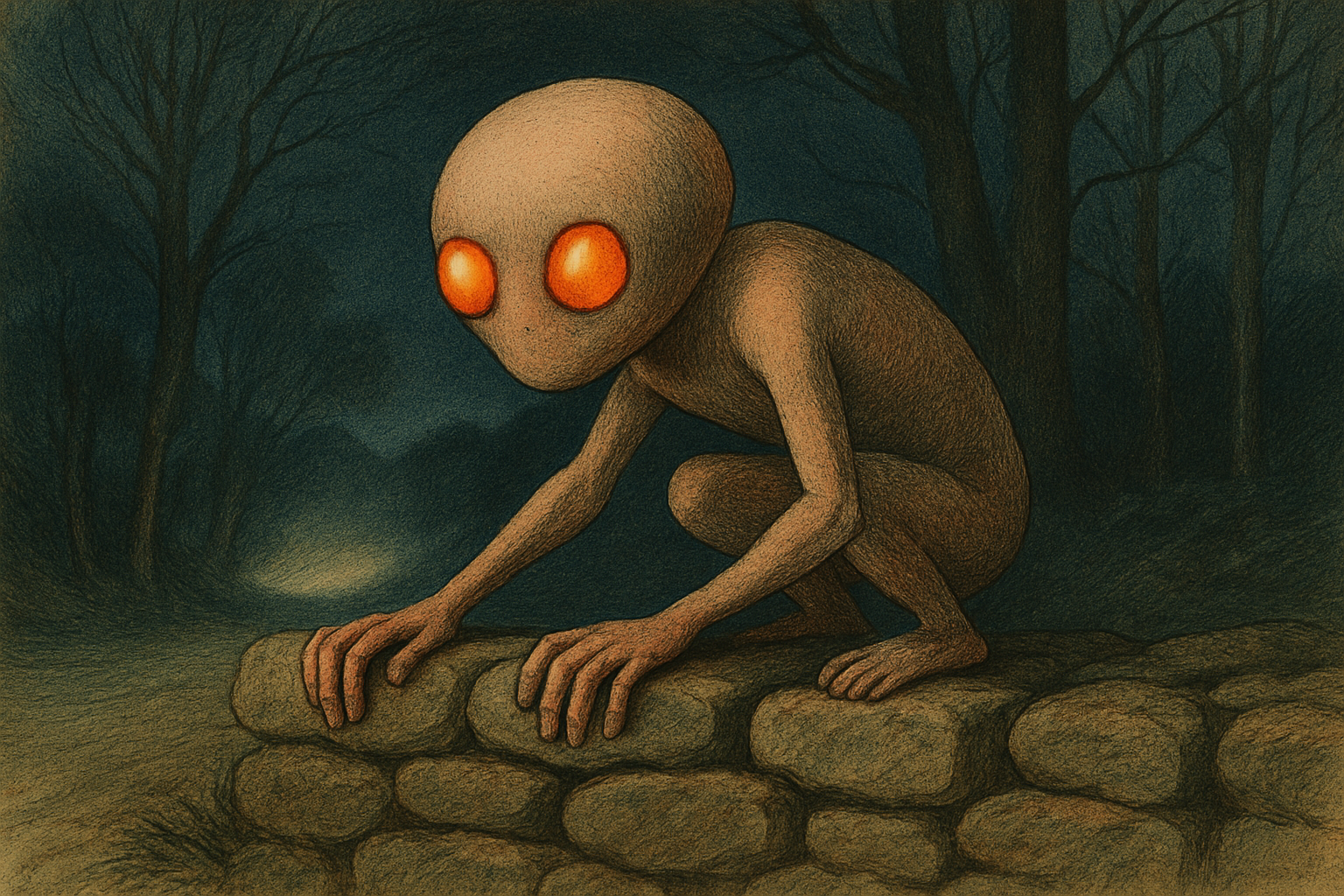
Just after 10:30 on the night of April 21, 1977, seventeen-year-old Bill Bartlett was driving north on Farm Street in Dover, Massachusetts, with two friends in the car. His headlights swept across a low stone wall, and on top of it he saw something that did not resolve into anything he could name. It was small — the size of a child or smaller — with a large, watermelon-shaped head disproportionate to a spindly, hairless body. Its long, thin fingers gripped the rocks. Its eyes, he said, glowed orange like two marbles catching the light. Bartlett was an art student. When he got home, badly shaken, he drew what he had seen. Within twenty-five hours, two other Dover teenagers — who did not know what Bartlett had reported — would independently describe nearly the same thing.
What makes the case endure is not the strangeness of that first sighting alone. Strange one-off reports are common, and most evaporate under scrutiny or simply never get a second look. The Dover Demon is different because it arrived in a burst — three sightings, three separate witnesses, three separate locations — and then stopped as abruptly as it began. There was no build-up of local legend beforehand, no string of earlier scares that might have primed the teenagers to see a monster. And in the decades since, nothing has been added to the file. The creature appeared, was described in near-identical terms by people who had not compared notes, and then vanished from the record entirely.
The Location
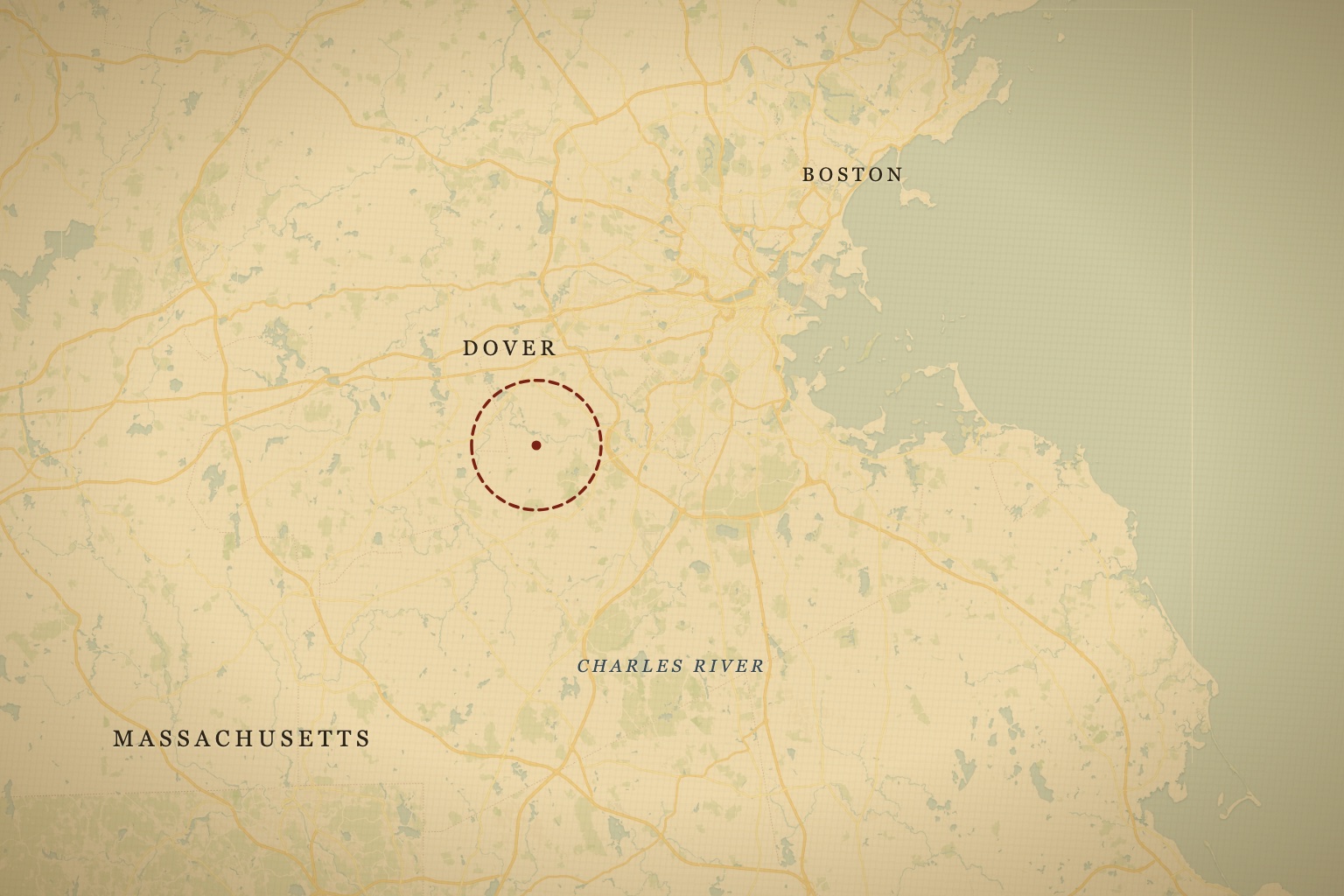
Dover sits about fifteen miles southwest of Boston in Norfolk County, an affluent, heavily wooded suburb along the Charles River. It is not wilderness in any meaningful sense — this is exurban New England, a town of large lots, horse properties, stone walls, and second-growth forest threaded through a low network of two-lane roads. In 1977 its population was under 5,000, and it remains one of the smallest and wealthiest towns in eastern Massachusetts.
That demographic detail matters more than it might seem. Dover in the late 1970s was a place with few streetlights, little through traffic, and a rural character that had survived even as Boston's suburbs crept outward. The stone walls that run along its roads are the fieldstone remnants of colonial-era farms, mortarless and moss-covered, exactly the kind of low ledge a small figure could be seen perched on in a passing headlight beam. The forest is mixed New England hardwood — oak, maple, birch — interrupted by wetland, glacial erratics, and shallow gullies where a wooded slope drops away from the road. None of it is dramatic. There are no cliffs, no gorges, no vast unbroken tracts of timber.
The terrain that matters here is intimate rather than vast. The three sightings all occurred within a roughly two-mile radius, along Farm Street, Miller Hill Road, and Springdale Avenue — quiet rural lanes bordered by old fieldstone walls, mixed hardwood forest, wetland, and glacial boulders. Elevation is modest, rarely exceeding a few hundred feet. This is exactly the kind of landscape that makes the Dover case unusual for cryptid work. There is no deep backcountry, no roadless interior, no ecosystem obviously capable of hiding a breeding population of anything large or strange. The Dover Demon was not reported in the remote timber where such things are usually placed. It was reported on the shoulder of suburban roads, within walking distance of houses, in a town where a person could not easily disappear — and neither, it would seem, could a creature.
That compression is the whole geographic story. Bigfoot reports cluster in the Pacific Northwest because there is genuinely somewhere for a large animal to be unobserved. Lake monster reports attach to deep, cold, poorly surveyed water. Dover offers neither. A person standing on Farm Street is never far from a driveway, a mailbox, a lit window. Whatever the three teenagers saw, they saw it in an environment that offers a monster nowhere to live and nowhere to go — which is precisely why the case resists the usual explanations that depend on remote habitat.
The Sightings
The Dover reports are remarkable precisely because they compressed into a single weekend and then stopped completely.
Bartlett's account was the first: the creature on the wall on Farm Street, roughly the size of a small child, hairless, with a bulbous head and glowing orange eyes. His two passengers did not see it, but he described it in detail immediately afterward and produced a sketch — one that would become the case's defining image, annotated in his own hand: "I, Bill Bartlett, swear on a stack of Bibles that I saw this creature." The drawing shows a figure with a top-heavy head far too large for its frame, no visible hair or features beyond the eyes, and slender limbs ending in elongated fingers wrapped over the edge of the wall. Bartlett later described the skin as rough or sandpaper-textured. He was rattled enough by the encounter that his father noticed his state when he arrived home.
Roughly two hours later, around midnight, fifteen-year-old John Baxter was walking home along Miller Hill Road when he saw a small figure ahead of him in the dark. He initially thought it was a friend or a small person. As he approached, it moved away, and he followed it down a shallow gully, where he saw it clearly braced against a tree — the same thin body, oversized head, and long fingers gripping the trunk. He backed off and went home. Baxter, too, made a drawing. He had not spoken to Bartlett. His sketch emphasized the figure in profile, feet against the base of a tree on the far side of the gully, the head again grossly out of scale with the body.
The following night, April 22, fifteen-year-old Abby Brabham was riding in a car driven by eighteen-year-old Will Taintor on Springdale Avenue when she saw a creature crouched by the roadside in the headlights. Her description matched the others — hairless, large-headed, spindly — with one notable divergence: she reported the eyes as glowing green rather than orange. Taintor, driving, caught only a brief glimpse and could not confirm the detail she described, but Brabham was insistent about what she had seen in the beam. Three teenage witnesses, three separate locations, roughly twenty-five hours, and a strikingly consistent description of something that fit nothing in the known fauna of Massachusetts.
The single-eye-color discrepancy is worth sitting with rather than smoothing over. Orange and green are not close, and the difference has been used both ways — as evidence the witnesses were describing genuinely separate observations rather than a rehearsed shared story, and as evidence that the "creature" was fluid enough to shape-shift in the retelling. What is not in dispute is the structure everyone agreed on: the disproportionate head, the hairlessness, the thin limbs, and the long grasping fingers. Those are the load-bearing details, and they held across all three accounts.
The Evidence
There is no physical evidence in the Dover Demon case. No tracks were cast, no hair recovered, no photographs taken, no audio recorded. What the case produced instead — and what has kept it alive for nearly fifty years — is testimonial: the drawings and the independence of the witnesses.
That independence was investigated at the time by Loren Coleman, the veteran cryptozoologist, who reached Dover within days and interviewed the witnesses and their families. Coleman, along with several other local researchers, worked to establish whether the three teenagers could have coordinated their stories. His conclusion was that they had not had meaningful opportunity to compare notes before reporting, and that their accounts converged on details — the hairlessness, the disproportionate head, the long fingers, the glowing eyes — that were specific and unusual rather than generic. Coleman is generally credited with coining the name "Dover Demon," a label chosen partly for alliteration and press appeal rather than any demonic quality attributed to the creature itself. The name stuck, and it helped carry the case into the national press and the cryptozoological literature — and eventually onto television: Animal Planet's Lost Tapes dramatized the sightings in a 2009 episode, and Destination America's Monsters and Mysteries in America revisited the case in a later season alongside other New England cryptids.
The drawings deserve to be treated as the core artifact of the case, because they are effectively all the primary evidence there is. Bartlett was an art student, which cuts in more than one direction: it lends credibility to the accuracy of his rendering, but it also means the defining image of the phenomenon came from someone trained to draw convincingly. Baxter's independent sketch, made without seeing Bartlett's, is the crucial corroborating document — two hand-drawn figures, produced separately, showing the same anatomical impossibility.
The skeptical counter is equally real and deserves to be stated plainly. Martin Kottmeyer and others have argued the sightings are consistent with misidentified known animals — a foal, a young moose, or, most persuasively, a sick or newborn animal glimpsed at night — filtered through the imagination of teenagers and reinforced by rapid word-of-mouth in a small town. A newborn moose calf, for instance, has long spindly legs and an oversized head relative to its body, and could plausibly be startled and freeze in headlights. Others have raised the possibility of a sick or injured animal moving abnormally. What no explanation fully accounts for is why the descriptions cohere as tightly as they do, why witnesses reported no fur on an animal that should have had it, and why the phenomenon never recurred. A misidentification pattern usually repeats — if young moose or foals are being mistaken for demons, it should happen more than once. This one happened once.
The Verdict
The Dover Demon is the rarest kind of cryptid case: a tight cluster of credible-seeming reports with no lead-up and no aftermath. It is not a hotspot. It is a single weekend, geographically compressed, that has never been added to. That fact cuts both ways. It undercuts the idea of a resident population — nothing has been reported in the Farm Street corridor in the decades since — but it also frustrates the easy skeptical dismissal, because one-off events resist the pattern-of-error explanations that work so well on recurring hotspots.
There is a further wrinkle that makes Dover unusually clean as a test case. The witnesses did not seek publicity, and by most accounts have not tried to monetize or dramatize the encounter in the years since. Bartlett in particular has consistently maintained over the decades that he saw something real and does not have an explanation for it, while declining to inflate the account. That steadiness — neither recanting nor embellishing — is itself part of why the case has aged better than most. Stories that grow in the telling tend to reveal themselves. This one has stayed roughly the same size since 1977.
For the serious investigator, Dover offers little to work with in the field. There is nothing to track, no terrain to survey, no habitat to model. What it offers is a case study in witness testimony under the cleanest possible conditions — young, unrelated observers, minimal contamination, contemporaneous drawings, and a landscape too small and too settled to hide the usual explanations. The Dover Demon is less a creature to be found than a question about what three teenagers actually saw on those two spring nights — a question that, forty-nine years on, still has no comfortable answer.
Track sighting locations from this post on the interactive map.
Free account · mark visited sites · build your field list.
Open the tracker