The Mothman of Point Pleasant: What the Witnesses Actually Saw
Point Pleasant
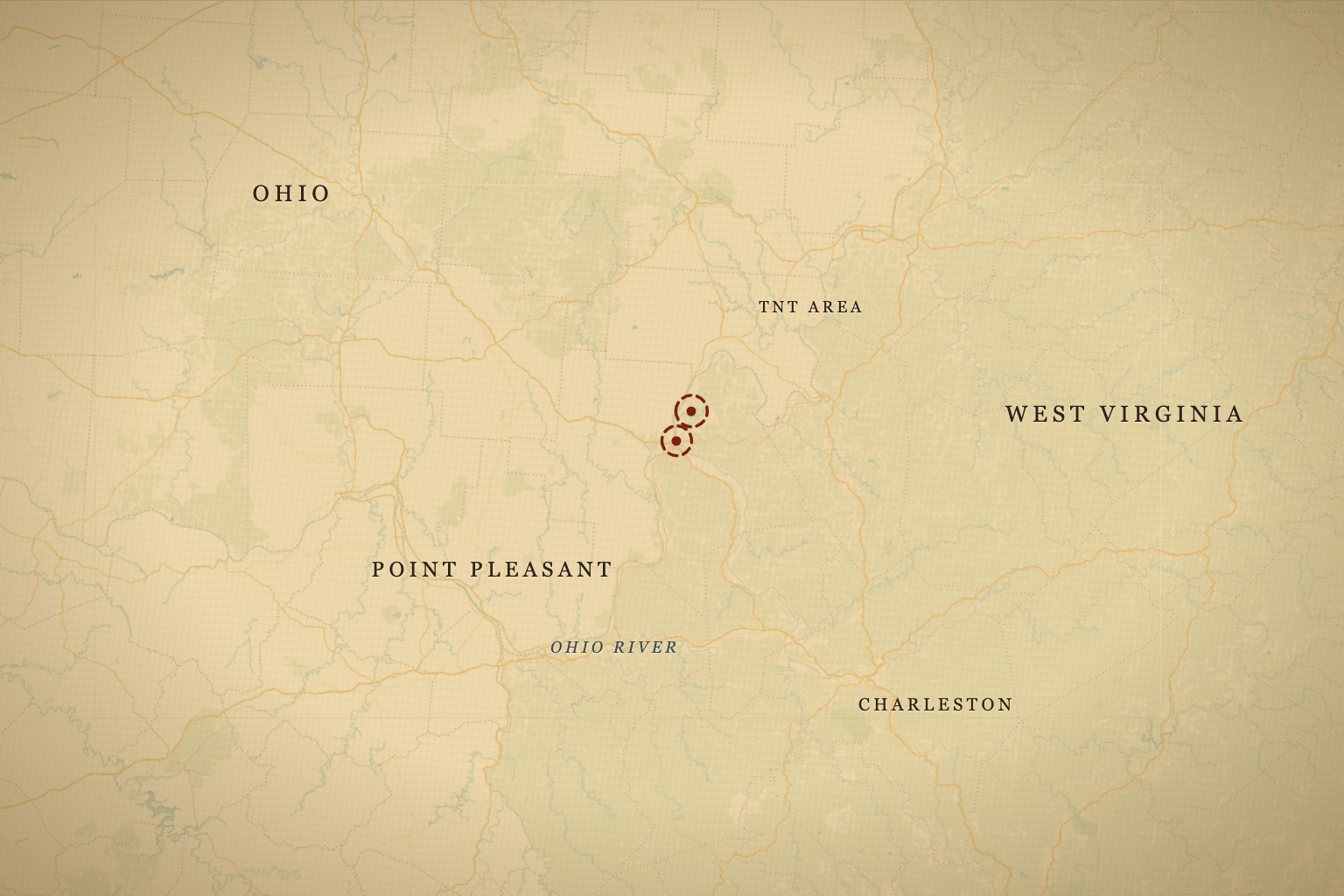
Point Pleasant, West Virginia sits at the confluence of the Ohio and Kanawha Rivers in Mason County — elevation roughly 570 feet, population around 4,000 at the time of the sightings. It is a river town, flat in its center and ringed by wooded ridges. In 1966, it was also bordered to the north by one of the stranger pieces of real estate in the region: a decommissioned WWII-era munitions complex that locals simply called the TNT Area.
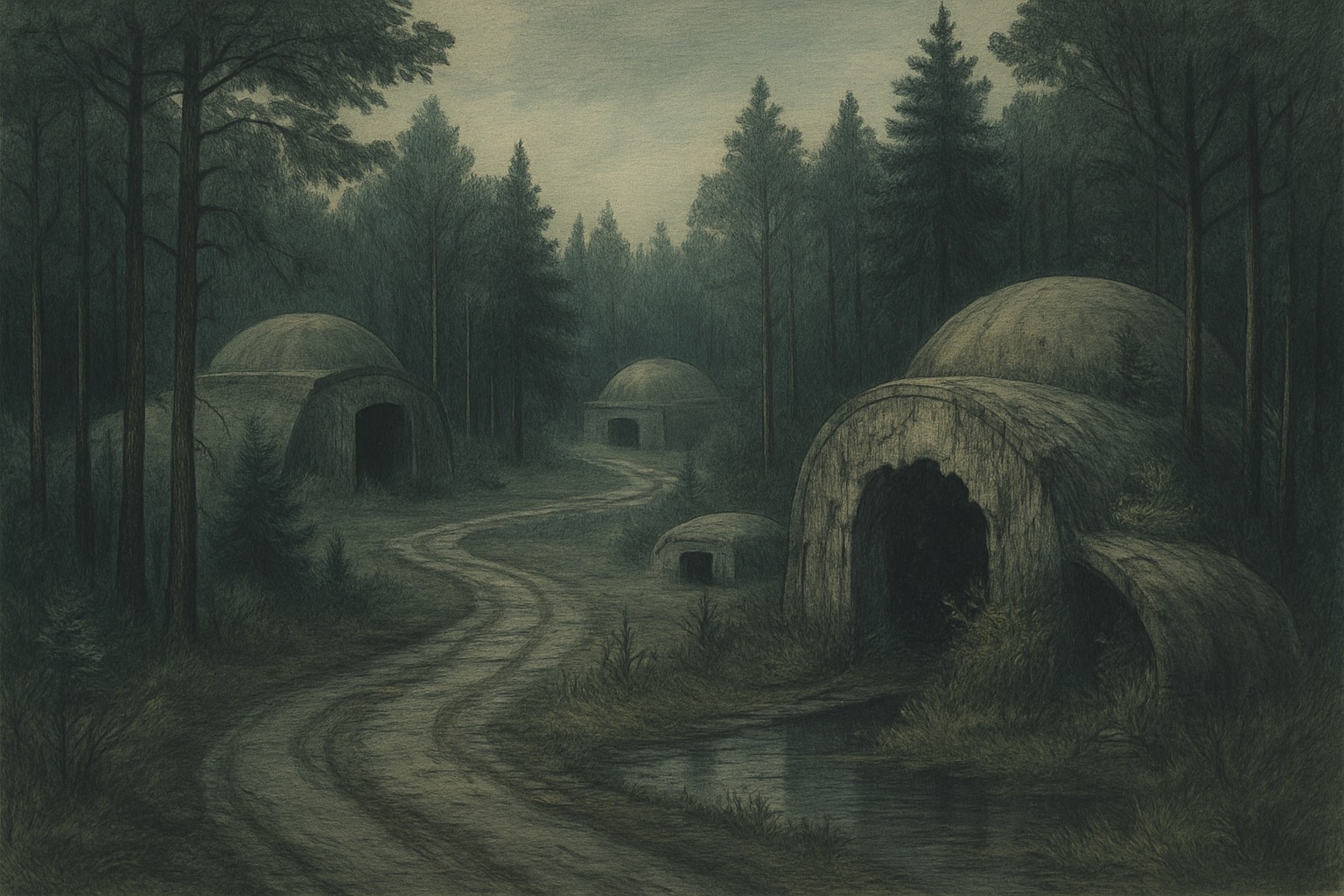
The TNT Area — formally the West Virginia Ordnance Works — produced TNT from 1942 to 1945 and was then partially absorbed into what became the McClintic Wildlife Management Area, roughly 2,500 acres of reclaimed forest and wetland. What makes the place genuinely unsettling, even today, is what the Army left behind. Scattered through the second-growth timber are more than a hundred concrete igloos — dome-shaped ordnance storage bunkers built to hold explosives at safe distance from one another. Many are still standing. Many are partially collapsed, their roofs caved or their entrances choked with vegetation, the interiors dark and damp and large enough to walk into. The service roads that once connected them are crumbling. The soil in places remains contaminated with decades-old chemical byproduct.
This is the terrain where the Mothman wave began, and where the majority of reports originated. The environment matters for two reasons, and they pull in different directions. First, it is ideal habitat for large roosting birds: dense cover, abundant prey, standing water, minimal human traffic, and a hundred dark hollow structures that make natural roosts and shelters. A big bird could live in the TNT Area for years without being properly identified. Second, the place is eerie in a way that is not subtle. Empty munitions bunkers in a dark forest put people on edge before anything unusual happens. That context does not debunk the sightings — but it does help explain why so many witnesses were already paying close attention to the treeline.
What is remarkable is what the town did with the story afterward. Rather than bury an embarrassing episode, Point Pleasant made the Mothman part of its identity. A 12-foot stainless-steel statue of the creature — wings spread, red eyes, gleaming and deliberately strange — stands in a small plaza downtown and has become the town's most photographed landmark. The Mothman Museum operates at 400 Main Street, holding the most comprehensive archive of physical documentation from the wave. And each September the town hosts the Mothman Festival, which now draws upward of 10,000 visitors over a single weekend. A community of 4,000 has built a durable civic memory around an event most towns would have spent sixty years denying. For a field researcher, that openness is an asset: the witnesses, and the people who knew them, were never pressured into silence.
The Witnesses
This is the core of the case, and it deserves to be handled carefully. The Mothman is not a single dramatic sighting. It is a sustained, cross-referenced body of independent testimony, and the people involved were ordinary residents who had nothing obvious to gain.
The foundational report came on the night of November 15, 1966. Two young married couples — Roger and Linda Scarberry and Steve and Mary Mallette — were driving near the TNT Area when their headlights caught a large gray figure standing near an old generator building. They described it as roughly man-shaped, six to seven feet tall, with massive wings folded against its back and, most consistently, two eyes that glowed red when the light struck them. They did not describe a beak, a face, or feathers in any conventional sense. As they accelerated away, the figure took to the air and pursued their car down Route 62 toward town. All four reported that it kept pace with them at speeds exceeding 100 miles per hour, gliding rather than flapping, the red eyes holding steady behind them. They did not call a newspaper. They drove straight to the Mason County courthouse and reported what they had seen to Deputy Millard Halstead, who took them seriously enough to drive back out to the TNT Area with them that same night. Four witnesses, one account, given immediately and without prompting to law enforcement — that is the bedrock the entire case rests on.
The next night, November 16, Marcella Bennett experienced one of the most distressing encounters of the wave. She had driven to a home near the TNT Area, her infant daughter with her, when the creature rose from the ground close to her car. Bennett froze in shock and dropped the child — she recovered her daughter immediately and ran for the house — but the detail has stayed with investigators for decades because it speaks to the rawness of the reaction. People do not generally drop their children. Her physical description matched the Scarberry-Mallette account almost exactly: a large gray man-shaped form, enormous wings, glowing red eyes. Bennett reported lingering distress for some time afterward.
The sightings continued through late November. On November 25, 1966, Thomas Ury was driving to work along Route 62 when he saw a tall gray figure standing in a field. As he watched, it spread its wings and rose into the air, and he reported that it followed his car along the route, circling above the vehicle as he sped toward town. Ury was badly shaken and reported the encounter the same morning. His account is valuable precisely because it was a daytime sighting by a single driver with no companions to influence his description — and it lined up with the others anyway.
Holding the record together was Mary Hyre, who ran the Point Pleasant bureau of the Athens (Ohio) Messenger, one of the most careful journalists in the region. Over the 13-month wave she documented more than 100 separate reports. She interviewed witnesses directly, cross-checked their accounts, and noted how consistent the specific physical details remained across people who had no connection to one another. Hyre also corresponded throughout with the author and investigator John Keel, feeding him names, dates, and details as the events unfolded. Together their files form the most detailed contemporaneous record of any American cryptid wave.
Two further elements set this case apart, and both are uncomfortable. The first is the wave of Men in Black encounters reported during the same period. Multiple witnesses, including Hyre herself, described being visited by strange men in dark clothing who asked unsettling questions about what had been seen and, in some accounts, discouraged them from talking. This phenomenon is rarely discussed in serious treatments of the case, perhaps because it pushes the story toward the sensational — but it is part of the contemporaneous record, reported by the same credible witnesses, and honesty requires noting it rather than quietly editing it out.
The second is the ending. On December 15, 1967, the Silver Bridge — a 1928 eyebar-chain suspension bridge linking Point Pleasant to Gallipolis, Ohio — collapsed during evening rush hour. Forty-six people died. The Mothman sightings stopped, abruptly and almost entirely, after that night. Whatever one makes of it, the temporal correlation is a documented historical fact: thirteen months of mass sightings, then one of the worst bridge disasters in American history, then silence. No causal claim is required to find that sequence arresting.
What the witnesses consistently described, across more than a year and more than a hundred reports: a bipedal figure six to seven feet tall, a wingspan in the ten-to-fifteen-foot range, no obvious neck, eyes that glowed red under light, wings folded against the back at rest, and a flight speed that observers found impossible to reconcile with any bird they knew.
What the Shows Covered
The Mothman falls outside the scope of the flagship cryptid television franchises — Finding Bigfoot and Expedition Bigfoot both focus exclusively on Sasquatch and do not investigate flying cryptids or river-town reports. But the absence of a marquee TV investigation does not mean the case went undocumented. If anything, the Mothman has one of the deepest and most credible documentary records in the field, and it came from on-the-ground work rather than a film crew parachuting in.
That work belongs first to John Keel. Keel did not write about Point Pleasant from a distance. He was physically present in the town during the wave, repeatedly, throughout 1967 — interviewing witnesses, walking the TNT Area, corresponding with Mary Hyre, and experiencing some of the stranger peripheral phenomena himself. His 1975 book, The Mothman Prophecies, remains the primary investigative text on the case. It is not a tidy book, and Keel's later interpretations drift well past where the evidence can follow him, but the underlying fieldwork — the names, the dates, the cross-checked testimony — was gathered in real time by someone who was actually there. For primary-source purposes, Keel and Hyre are still the starting point.
The 2002 Richard Gere film, also titled The Mothman Prophecies, carried the case to a mainstream audience. It is dramatized and should be treated as such, but it is loosely grounded in the documented incident record and it sent a generation of curious people back to Keel's original reporting. That is a fair use of an adaptation.
The most underrated piece of documentation, though, is the festival itself. The annual Mothman Festival functions as a form of living community memory-keeping. Each September it brings researchers, investigators, and — crucially — surviving witnesses and their families into the same place. For someone approaching this as a field researcher rather than a tourist, the festival and the Mothman Museum at 400 Main Street remain among the best venues anywhere for accessing firsthand testimony from people who were present in 1966 and 1967. A town that keeps its witnesses talking, decade after decade, is doing more to preserve the evidentiary record than most televised investigations ever manage.
Field Assessment
Honesty first: there are strong natural candidates here, and they deserve to be taken seriously rather than waved away.
The most credible is the sandhill crane (Antigone canadensis). It is a large migratory bird with a wingspan that can approach seven feet, it stands several feet tall, it has a distinctive patch of bare red skin around the eyes, and it is a capable, fast flier. A sandhill crane is rare in West Virginia but not impossible, and a startled one caught in headlights — tall, gray, red around the eyes, suddenly airborne — could plausibly account for the broad shape of the original sightings. Any responsible assessment of the Mothman has to put the sandhill crane at the top of the list. The barn owl (Tyto alba) is a secondary candidate: its eyes reflect light in a way that can read as red, and against a dark background in a car's headlights it can appear startlingly large and disturbing. Cold War anxiety and the social dynamics of a small, tight-knit town would have amplified both.
And yet simple misidentification is less satisfying than it should be, for reasons that are specific rather than romantic.
There is the scale problem. A seven-foot crane wingspan is real, but witnesses repeatedly reported ten to fifteen feet, a bipedal man-shaped stance rather than a bird's profile, and sustained flight at speeds exceeding 100 miles per hour while pacing a moving car. Cranes and owls do not do that. There is the consistency problem. More than a hundred reports over thirteen months, from people with no apparent contact with one another, converged on the same unusual specifics: the glowing red eyes, the wings folded flat against the back at rest, the gray coloration, the speed. Misidentification tends to produce scattered, contradictory descriptions. This wave did the opposite. And there is the character of that first report. The Scarberrys and the Mallettes did not call a newspaper looking for attention — they drove to the courthouse and told a deputy, immediately, and the deputy went back out into the dark with them. That is not the behavior of a hoax.
What remains is one of the most thoroughly documented cryptid waves in American history. The witnesses were not fringe figures: they were young married couples, a mother with her infant, a man driving to work, sheriff's deputies, and a respected regional journalist. Their accounts were recorded as the events happened, cross-checked against one another, and found to be internally consistent. The physical evidence — a body, a clear photograph, a feather — is thin to nonexistent. The witness testimony is neither.
That is the tension at the heart of the case, and the honest move is to sit with it rather than resolve it prematurely in either direction. The sandhill crane probably explains some of what was seen near the TNT Area in those thirteen months. It does not comfortably explain all of it. A field researcher's job is to hold both of those statements at once.
Track sighting locations from this post on the interactive map.
Free account · mark visited sites · build your field list.
Open the tracker