The Ogopogo of Okanagan Lake: Canada's Best-Documented Lake Mystery
Before the Name
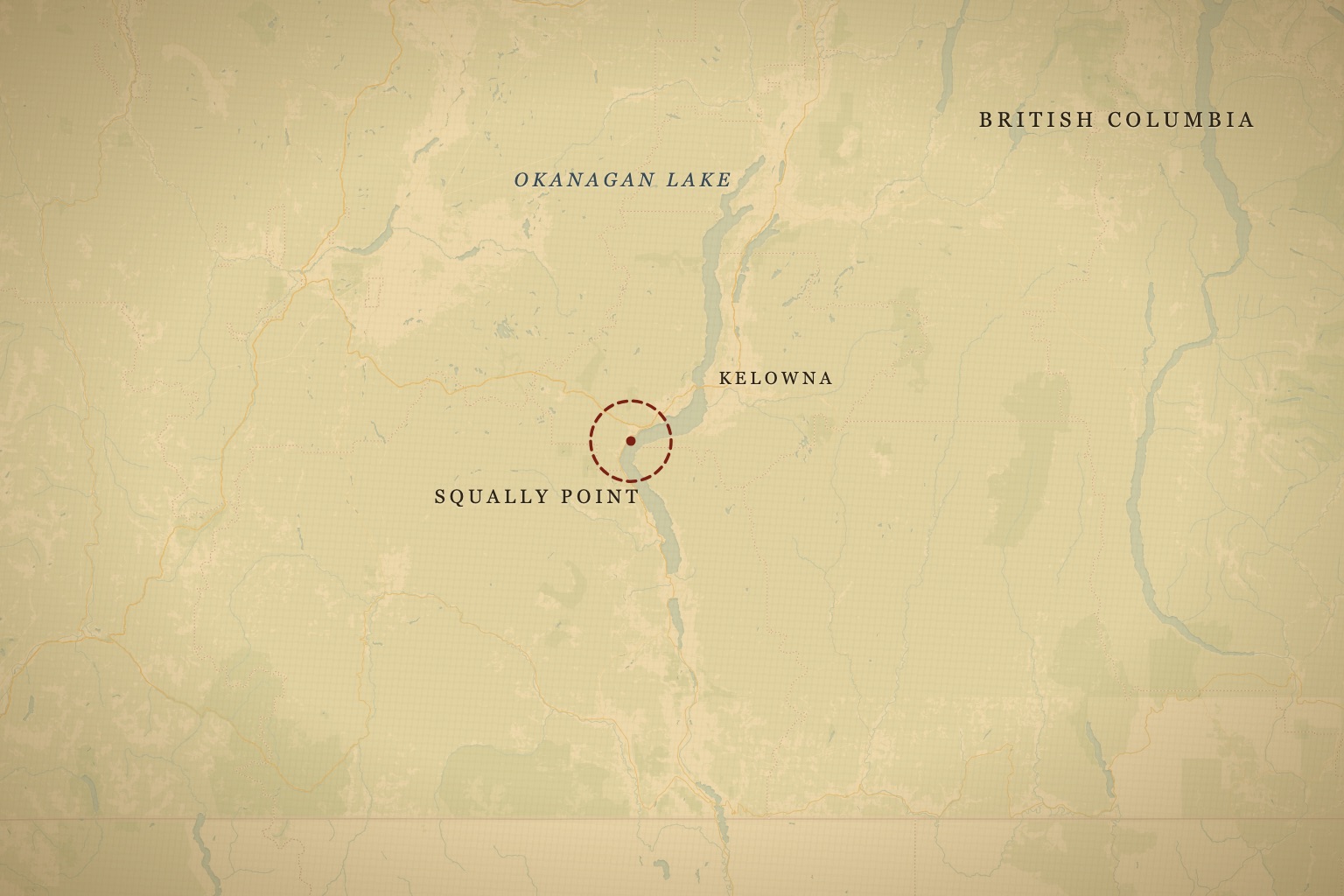
Long before anyone called it Ogopogo, the Syilx (Okanagan) people of British Columbia's interior knew of n̓x̌ax̌aitkʷ — often rendered N'ha-a-itk — the sacred spirit of Okanagan Lake. The tradition centered on the waters near Squally Point and Rattlesnake Island, on the lake's western shore, where travelers crossing by canoe were said to make offerings before passing; settler-era retellings describe small animals dropped into the water as tribute before paddling the exposed crossing. It's worth stating plainly: in the Syilx tradition this was not a monster. It was a powerful presence in the water, to be respected — a protector of the lake, tied to how people were expected to behave on it. The "lake monster" framing came later, from settlers — and Syilx knowledge keepers have pushed back on the distortion ever since. Any honest account of Ogopogo starts there.
The settler record starts early too. In 1872, Susan Allison, one of the first non-Indigenous settlers in the region and one of its first chroniclers, reported seeing something large moving against the wind in the lake — swimming into a storm-driven chop that should have pushed any log the other way. Reports accumulated through the late 1800s and early 1900s, from ranchers, ferry passengers, and priests, and by the 1920s the creature had a following. The name itself is an import: it comes from a 1924 English music-hall song, "The Ogo-Pogo," and — as the story is usually told — got attached to the lake's creature at a Vernon service-club luncheon in 1926, as a joke that outlived everyone in the room. By the end of 1926 the name was permanent. That same year, when the new ferry was commissioned at Kelowna, the often-repeated story goes that there were half-serious calls to fit it with devices to repel the monster. The tourist creature and the sacred being have coexisted uneasily ever since — though there has been a late correction: in 2021, the City of Vernon formally transferred its decades-old Ogopogo copyright to the Okanagan Nation, an acknowledgment of whose story this was first.
The Location
Okanagan Lake is a serious piece of water. It runs about 135 kilometers through the Okanagan Valley of south-central British Columbia, from Vernon in the north past Kelowna to Penticton in the south. It is a deep, fjord-like glacial lake — its maximum depth is roughly 230 meters — carved by ice and filled with cold, dark water that rarely freezes over completely. Below the sunlit surface layer, the lake is a black, thermally stratified volume that no diver has meaningfully surveyed; it holds kokanee salmon, rainbow trout, and whitefish in quantities that could, in principle, feed something large.
That geometry matters for both sides of the argument. A lake this long, deep, and cold could plausibly conceal a large, rarely surfacing animal. But a lake this long also generates strange surface effects: boat wakes travel enormous distances and rebound off shorelines, arriving minutes after the boat that made them has vanished from view; wind lines and standing waves form and break where currents meet; seiches — slow oscillations of the whole water body — push water in directions the wind doesn't explain; and floating logs from a century of timber operations ride low in the water, occasionally rising and wallowing as they become waterlogged. On calm days, temperature layering over the surface produces mirage effects that stretch and animate distant objects. Okanagan Lake manufactures Ogopogo-shaped illusions as a matter of physics. The question has always been whether it manufactures all of them.
One more feature distinguishes this lake from almost every other "monster" lake in the world: people. The Okanagan Valley is one of the fastest-growing regions in Canada, and the floating bridge at Kelowna — first opened in 1958, replaced by the William R. Bennett Bridge in 2008 — carries tens of thousands of crossings a day directly over the water. Loch Ness is watched by tourists; Okanagan Lake is watched by commuters, every day, for generations. That density of eyes should either have solved the mystery or drowned it in noise. It has somehow done neither.
The Sightings
The signature mass sighting is from September 1926, at Okanagan Mission beach near Kelowna, where — as the story has been told and retold — the occupants of some thirty cars reported watching something large moving in the lake. The number of vehicles is hard to verify at this distance, but the event was reported at the time and became the anchor of the modern record. It also came at the exact cultural moment the new name was spreading, which skeptics note and proponents concede: 1926 was the year the lake was being watched hardest.
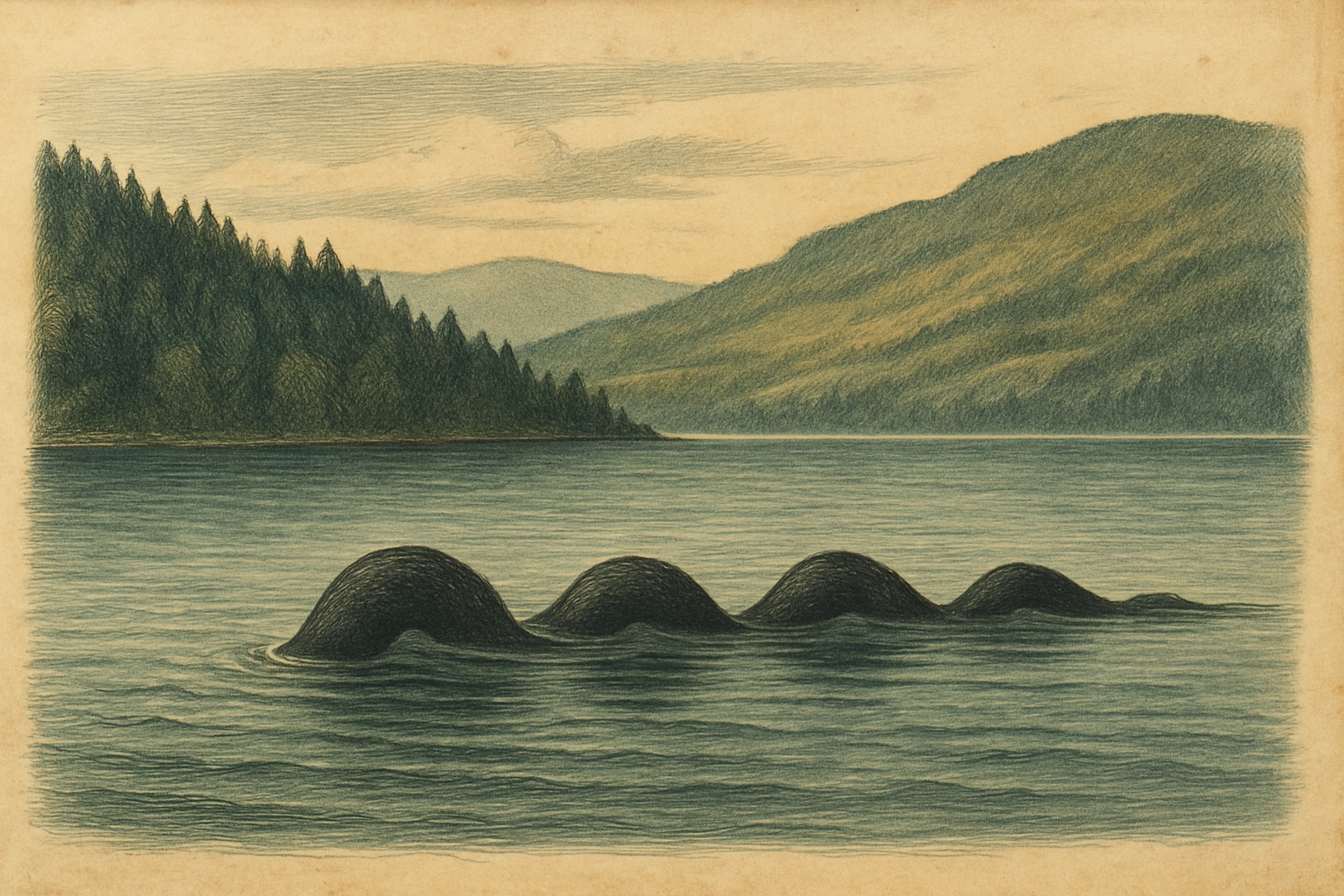
Reports have continued in a steady drip ever since, typically describing a dark, multi-humped form 20 to 50 feet long moving against the wind or leaving a wake with no boat attached. The consistency of those two details across decades is the pattern worth taking seriously — motion against the wind and wakes without vessels are precisely the observations that wave trains and drifting logs explain worst. In September 2018, three separate reported sightings within a single month put the lake back in international headlines.
The case has also had unusually persistent chroniclers. Arlene Gaal, a Kelowna author, spent more than three decades collecting reports, photographs, and film — her archive of witness accounts, built up across several books, is the closest thing the lake has to a case file. Researchers with the British Columbia Scientific Cryptozoology Club, notably John Kirk, have long argued that Ogopogo has a stronger observational record than Loch Ness — more sightings, more independent witnesses, better viewing conditions. Kirk's position is not that the record proves an unknown animal; it's that the record is too large and too consistent to be dismissed without examination. On that narrower claim, he's simply right.
The creature's standing in Canadian culture reflects that record. In 1990, Canada Post put Ogopogo on a stamp in its folklore series alongside the Sasquatch and the Kraken, and statues stand on the waterfronts at Kelowna and Penticton. Whatever is or isn't in the lake, the sightings have been continuous enough, for long enough, to become part of the national furniture.
The Evidence
The film record is real but frustrating. In 1968, Art Folden — a sawmill worker driving Highway 97 with his family — shot roughly a minute of 8mm footage near Peachland showing a large disturbance moving through the water near shore. Folden sat on the film for months, showing it only to family, before it became public; it remains the most-analyzed piece of Ogopogo evidence, and still unresolved. Enhancement work over the years has established that something large is genuinely moving through the frame and submerging — but not what. The distance, the era's film stock, and the lack of foreground reference defeat every attempt at a definitive measurement.
In 1989, Ken Chaplin captured video of an animal swimming and slapping its tail near the lakeshore; analysts widely concluded it was a beaver, and even many Ogopogo proponents accept that identification. That episode matters as much as the Folden film, because it shows the community's error-correction working: a sincere witness, a real video, a mundane answer, accepted. Numerous later videos show wakes, humps, and dark shapes that resolve, on scrutiny, into wave trains or wood — or don't resolve at all. A Japanese television expedition in 1991 brought sonar and a remotely operated camera to the lake and came home with nothing conclusive.
What's missing is what's always missing: a carcass, bones, clear close-range photography, or a confirmed biological sample. A century of shoreline development has never turned up remains. Proposed candidates have included giant lake sturgeon — a tempting fit, since sturgeon are huge, bottom-dwelling, live for decades, and surface rarely — but no sturgeon population has ever been confirmed in Okanagan Lake, despite the fact that a breeding population of hundred-year-old fish should eventually be caught, snagged, or found dead. Otters swimming in a line, which produce an eerily convincing serpentine hump pattern of dark curves rising and dipping in sequence, likely account for a share of reports — including, plausibly, some of the multi-humped classics. Waterlogged timber rolling in a seiche accounts for more. Whether the residue after those subtractions is zero is the entire debate.
The Verdict
Okanagan Lake holds a genuinely layered record: an Indigenous tradition centuries older than the tourist name, a settler sighting history running back to 1872, one stubborn piece of film, and a modern drumbeat of reports from a heavily populated shoreline. That last detail cuts against the usual escape hatch — this is not a remote wilderness lake, and thousands of people look at it every day. Most see waves. Some see something they cannot square with waves. And unlike Loch Ness, where a handful of famous photographs have collapsed under scrutiny, Okanagan's case has never rested on a single artifact that could fail; it rests on volume, and volume is harder to debunk in one stroke.
The sober assessment: the physical evidence is compatible with a lake that contains logs, otters, beavers, and remarkable wave mechanics — and nothing else. The observational record is larger and more internally consistent than that explanation comfortably covers. Both statements are true at once, and a serious investigator holds both.
For the field investigator, the lesson of Okanagan is about respect in two directions: for the witnesses, and for the people who knew these waters first. The Syilx never claimed a plesiosaur. They claimed the lake demanded respect. A hundred and fifty years of unexplained reports suggest that, at minimum, they were right about that.
Track sighting locations from this post on the interactive map.
Free account · mark visited sites · build your field list.
Open the tracker