The Skunk Ape of the Florida Everglades
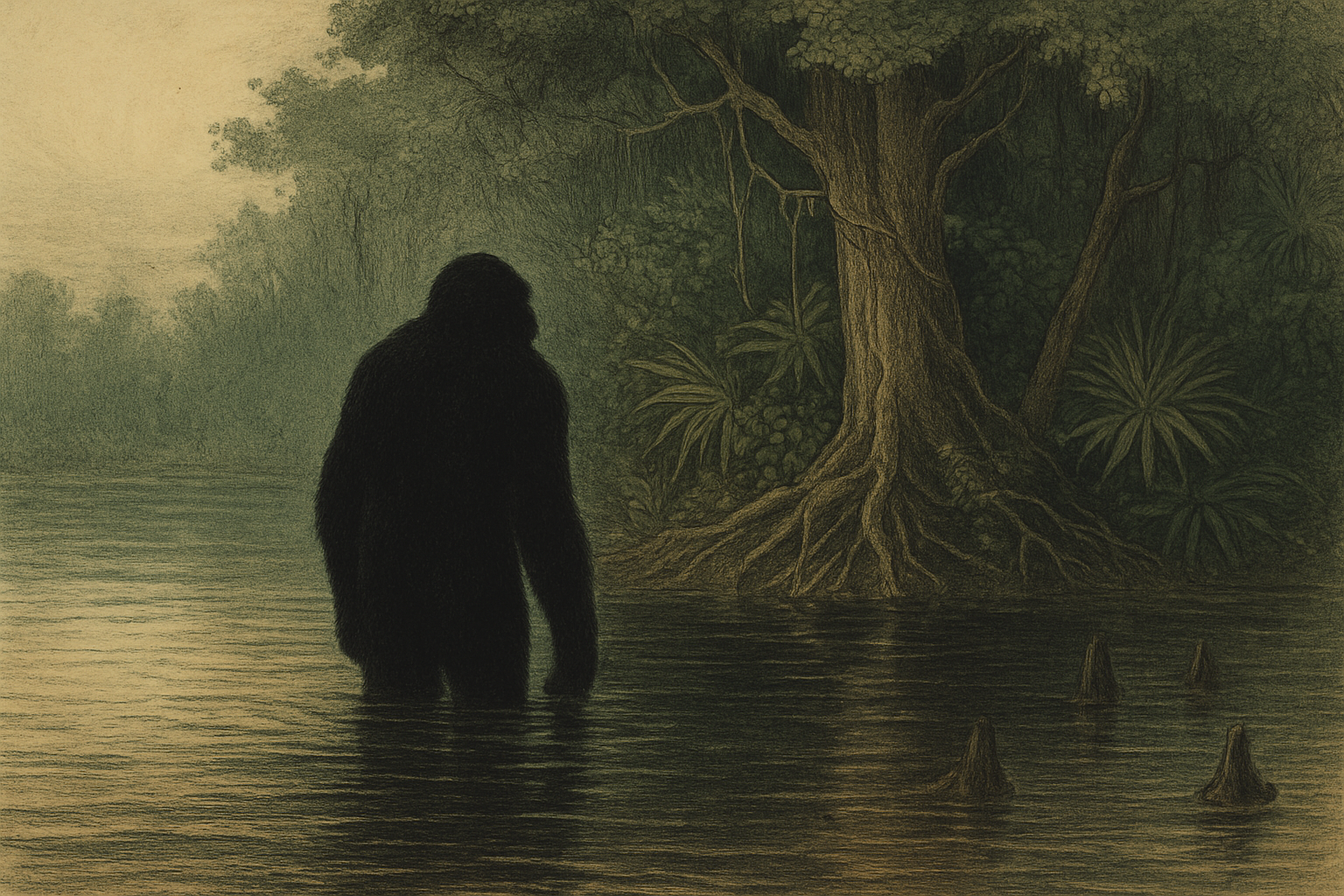
In December 2000, a woman in Sarasota County mailed the local sheriff's department two photographs and an anonymous letter. The images, taken at night with a flash, showed a large, dark, hair-covered figure crouched at the edge of her backyard, apparently reaching for green beans she had left out on the porch. She wrote that the animal had appeared on three consecutive nights, that it stood upright, and that it produced an odor she could not describe as anything but overwhelming. The photographs — since known as the "Myakka Skunk Ape photos" — became the most-circulated visual evidence in the entire history of the Florida cryptid. Whatever they show, they were not the beginning of the story. They were one entry in a report record that runs back more than a century, in a landscape uniquely built to hide exactly the kind of animal the letter described.
The Location
The Everglades are not a swamp in the ordinary sense. They are a river — a sheet of freshwater roughly sixty miles wide and only inches deep, flowing south from Lake Okeechobee across the flat limestone bedrock of South Florida toward Florida Bay. Everglades National Park protects 1.5 million acres at the southern end of that system, and to the north and west sit the Big Cypress National Preserve (729,000 acres) and a mosaic of state wildlife management areas, water conservation districts, and reservation land held by the Miccosukee and Seminole Tribes. Taken together, this is one of the largest subtropical wilderness complexes in North America.
The scale is hard to overstate. Everglades National Park alone is larger than the state of Rhode Island, and it represents only the protected southern terminus of a system that once stretched unbroken from the Kissimmee chain of lakes near Orlando all the way to the coast. Even after a century of drainage canals, levees, and agricultural conversion along its northern edge, the surviving core remains vast enough that portions of it are rarely if ever visited on foot. Federal and tribal jurisdiction over much of that land keeps development out and keeps roads few, which means the interior stays as inaccessible as any wilderness east of the Mississippi.
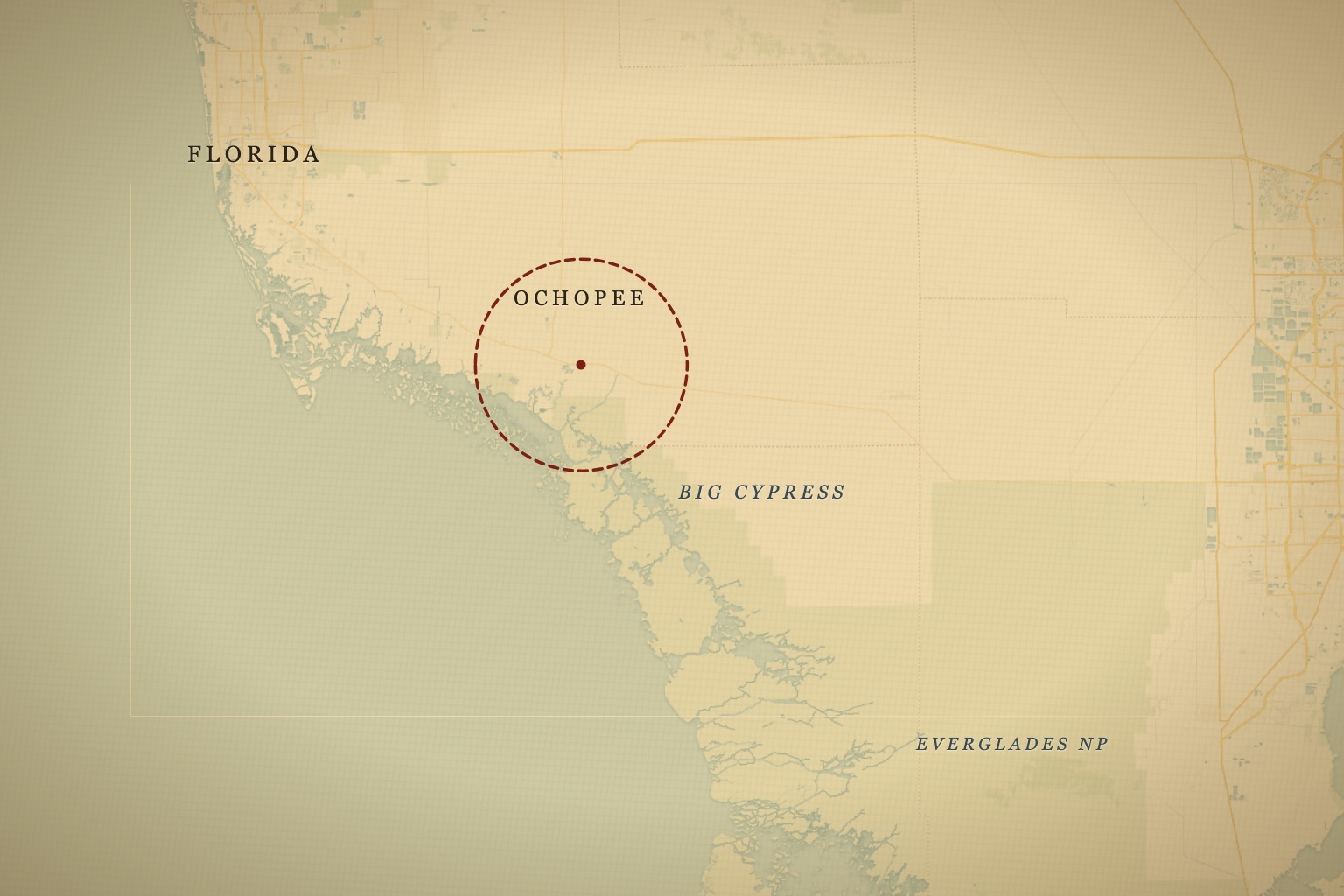
The terrain is a patchwork that defeats access on almost every axis. Open sawgrass prairie gives way to sloughs of deeper water, then to tree islands — hardwood hammocks and cypress domes that rise a few feet above the waterline and stay dry enough to hold dense vegetation. These hammocks are the key feature for anyone thinking about concealment: they can be only an acre or two in size, ringed by water and choked with strangler fig, gumbo limbo, saw palmetto, and thick understory, and there are thousands of them scattered across the system. A person standing on one is often invisible from a hundred yards away, and moving between them requires knowing which sloughs are passable and which drop off into deep water. Much of the interior is reachable only by airboat, canoe, or wading, and even then only seasonally. The nearest population anchors are Naples to the west, Miami to the east, and the tiny community of Ochopee on US 41 (the Tamiami Trail), which cuts across the middle of the preserve. Heat, water, alligators, and cottonmouths make sustained human presence rare. It is, in short, terrain that hides things well.
The seasonal rhythm matters as much as the geography. South Florida runs on a wet season and a dry season rather than the four-season cycle of the north. From roughly late spring through fall, the summer rains flood the interior, raising water levels, dispersing wildlife across the landscape, and making overland travel nearly impossible. In the dry months the water recedes, animals concentrate around the remaining gator holes and deeper sloughs, and the tree islands become walkable. Any pattern in the sighting record has to be read against that cycle, because human access — and therefore the opportunity to see anything at all — swings dramatically with the water.
The Sightings
Reports of a large, upright, hair-covered animal in South Florida predate the modern Bigfoot era. Newspaper accounts from the early twentieth century describe an "ape" or "wild man" in the interior swamps, and the name "skunk ape" — a nod to the persistent, overpowering odor witnesses describe — entered common use in the 1960s and 1970s, when a wave of encounters along the developing edge of the Everglades drew statewide press.
That timing is not incidental. The postwar decades were exactly when South Florida's population exploded and subdivisions began pushing into land that had been marsh and pine flatwoods a few years earlier. The pattern that emerges is one of encounters concentrated at the seam — the edge where new human settlement met undrained wilderness. This is the same drainage-edge, transition-zone geography that shows up again and again in credible sighting clusters across the country, and in South Florida it was being created almost overnight as the metro areas of Miami, Fort Lauderdale, and Naples expanded outward toward the water conservation areas.
The most concentrated cluster came in 1974 in Dade County, on the suburban fringe where new subdivisions pressed against undeveloped land. Residents in the area west of Miami reported a tall, dark, foul-smelling biped on multiple occasions over a period of months, and the accounts drew coverage in the Miami press. As with the best cases elsewhere, what stands out is not a single dramatic sighting but the repetition — independent witnesses, over weeks, describing the same animal in the same drainage-edge terrain. Witnesses in these Florida accounts tend to converge on a consistent description: a bipedal figure taller than a large man, covered in dark hair, seen most often at dusk or after dark, and accompanied by that unmistakable smell. The consistency of the description across people who had no reason to coordinate is, as always, the part of the record that resists easy dismissal.
The figure most associated with the modern Florida record is Dave Shealy, a lifelong resident of Ochopee who has documented skunk ape reports for decades and operates the Skunk Ape Research Headquarters on the Tamiami Trail. Shealy has said he first saw the animal as a boy and has reported multiple encounters since, including video footage he captured in the interior of Big Cypress. His claims are contested and impossible to verify independently, but his value to the record is real: he has spent a lifetime in this specific terrain and has collected accounts from hunters, airboat guides, and residents who would otherwise never file a report. That last point is easy to underrate. The people who spend the most time deep in the Everglades — commercial airboat operators, frog hunters, gladesmen whose families have worked the swamp for generations — are precisely the people least likely to call a newspaper or a sheriff. A local clearinghouse, whatever one makes of its proprietor's own accounts, captures reports that would otherwise evaporate. It also anchors the phenomenon to Ochopee and the Tamiami Trail corridor, which runs straight through the middle of the preserve and functions as the one reliable human sightline into an otherwise trackless interior.
The Evidence
Physical evidence for the skunk ape is genuinely thin, and honesty requires saying so. The Myakka photographs remain the most-examined artifacts. Analysts have argued the subject could be a person in costume, a bear, or an unknown animal; the anonymity of the source and the absence of a controlled recovery make them impossible to authenticate either way. They are provocative and unresolved — no more, no less.
The case has drawn national television attention beyond the photographs themselves: MonsterQuest devoted a 2007 episode to the search for the skunk ape, Animal Planet's Finding Bigfoot filmed a Florida-set "Swamp Ape" episode in 2011, and Discovery's Expedition X investigated the Big Cypress backcountry in a later season — each production returning to the same Ochopee corridor Shealy has worked for decades. The Florida black bear is worth taking seriously as a candidate here: it is a real, large, dark-furred mammal native to the region, and a bear rearing up or reaching into a backyard for food can present a startlingly humanlike silhouette in a flash photograph. That explanation accounts for some sightings comfortably. What it accounts for less comfortably is the upright bipedal locomotion witnesses repeatedly describe, and the odor.
Track casts have been recovered in Big Cypress and adjacent areas, some showing a broad, five-toed print at sizes exceeding a human foot. But the Everglades present a specific casting problem: the muck and standing water that dominate the interior distort impressions badly, making clean, detailed casts far rarer here than in the firmer soils of the Pacific Northwest or the Appalachians. A footprint pressed into saturated marl or peat begins to slump and fill almost immediately, and a print left on a dry hammock may sit on ground too hard and root-bound to register anything at all. The soil that would take a good cast and the soil an animal would actually be crossing rarely coincide, and that mismatch alone explains a great deal of the physical-evidence gap without requiring anyone to be lying.
The recurring detail across most Florida reports is the odor — a sulfurous, rotten, methane-and-musk smell so consistent across unconnected witnesses that it became the animal's name. That consistency is difficult to explain, though the Everglades also produce natural sulfur and methane from decaying vegetation, which skeptics reasonably note. Anyone who has disturbed the bottom of a stagnant slough knows the swamp can generate genuinely foul gas on its own, and hydrogen sulfide — the rotten-egg smell — is a normal byproduct of the anaerobic decay that dominates a waterlogged, oxygen-poor environment. The honest position is that the odor is simultaneously the most distinctive feature of the report record and the feature most easily produced by the landscape itself. Whether witnesses are smelling an animal or smelling the swamp is a question the evidence cannot currently settle.
The Verdict
The skunk ape occupies an unusual place in the cryptid record: a report history well over a century deep, a landscape almost tailor-made for concealment, and a body of physical evidence thinner than the witness volume would suggest. The gap between those things is the whole story. The Everglades are not a place a large mammal would struggle to hide — they are a place where confirmed animals like the Florida panther persist at densities so low they went nearly undetected for decades. The panther is the instructive comparison. It is a real, large, breeding population of an apex predator that survived in this exact terrain while being so rarely seen that biologists spent years arguing over whether a viable population even remained. If a documented, radio-collared, actively studied species can vanish that thoroughly into these hammocks, the terrain's capacity to conceal is not in question.
If something else moved through the hammocks, the terrain would swallow the evidence exactly as it has. What the location tells us is that absence of proof here means very little. This is ground that resists cameras, casts, and search teams with equal indifference — the water ruins tracks, the vegetation blocks sightlines, the heat and the snakes and the alligators keep people out, and the sheer acreage guarantees that whatever crosses it does so mostly unwitnessed. None of that is evidence for the skunk ape. It is simply the reason the ordinary tools of disproof carry less weight in South Florida than almost anywhere else.
For the serious investigator, Big Cypress in the dry season — when the water drops and the tree islands become walkable — is the one window worth the trip. That is when the interior is accessible on foot, when animals concentrate in predictable places, and when a print stands a chance of surviving long enough to be found. Work the edges of the hammocks, pay attention to the wildlife that gathers around the remaining water, and take the odor seriously as a signal rather than dismissing it outright. Follow the odor before you follow the sawgrass.
Covered On Screen
- "Swamp Ape"[2]Finding Bigfoot · S1 E2
Track sighting locations from this post on the interactive map.
Free account · mark visited sites · build your field list.
Open the tracker